What Is Battle Royale? The Complete Beginner's Guide
Imagine this: one hundred players drop out of the sky onto an island with nothing but the clothes on their backs. Everyone scrambles for weapons, the safe area keeps shrinking, and players are eliminated one by one until a single survivor — or a single squad — stands alone. That is the battle royale, the genre that has dominated gaming charts for the better part of a decade and shows no sign of fading. Games like PUBG Mobile, Free Fire and Fortnite turned a simple, brutal idea into a global phenomenon with hundreds of millions of players, massive esports tournaments and a cultural footprint far beyond gaming.
Yet for someone who has never played one, the genre can look chaotic and intimidating. Why does everyone land in the same place? Why is the map getting smaller? Why did I die to someone I never saw? This guide explains everything from scratch: what defines a battle royale, how a typical match flows from the drop to the final circle, which games are worth your time (including the ones that run well on modest phones), and the starter tips that will take you from "eliminated in thirty seconds" to "regularly reaching the top ten" within your first week.
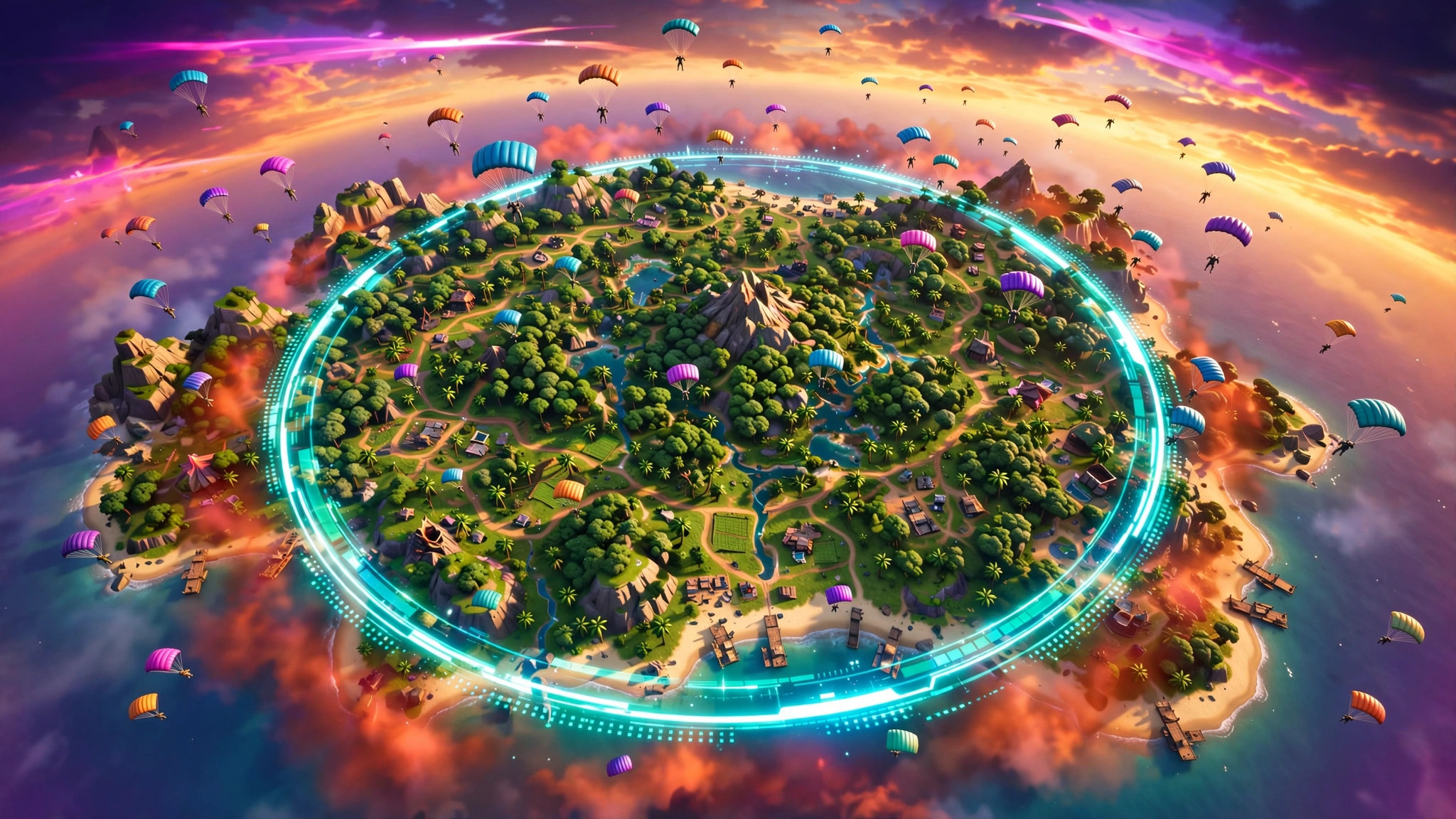
The Core Idea: Last One Standing
Every battle royale shares the same skeleton, no matter how different the games look. A large number of players — anywhere from 40 to 150, depending on the title — enter a single map at the same time with no equipment. Everyone starts equal. From there, the match is a race to become the last one alive, and the genre's genius is in how it forces the action to escalate.
Three systems do the heavy lifting. First, looting: weapons, armor, healing items and attachments are scattered across the map, so every match starts with a scramble. Your skill matters, but so does luck — the player who finds a good rifle in the first minute has a very different game from the one still holding a pistol. Second, the shrinking zone: an ever-contracting safe area (the "circle," "storm," or "zone" depending on the game) damages anyone caught outside it, herding players from a huge map into a tiny final arena. This prevents camping and guarantees the match ends in a tense, concentrated firefight rather than an endless stalemate. Third, elimination pressure: you get one life. There is no respawn in classic battle royale, which makes every decision — when to fight, when to run, when to heal — genuinely consequential.
The name comes from the Japanese novel and film Battle Royale, and the modern genre traces back to mods for games like Arma and Minecraft before PLAYERUNKNOWN'S BATTLEGROUNDS (PUBG) codified the formula in 2017. Fortnite's free-to-play battle royale mode launched the same year and brought the genre to hundreds of millions of players, many of them on phones.
Anatomy of a Match: Drop, Loot, Zone, Endgame
A battle royale match has a rhythm, and understanding it is the fastest way to stop dying early. Matches typically last 15–30 minutes, broken into distinct phases.
Phase 1: The Drop
Every match begins with the drop — parachuting, skydiving or gliding from a plane, bus or dropship onto the map. Where you land is the first real decision of the match. Popular "hot drops" (named locations like Pochinki in PUBG's Erangel or Tilted Towers in Fortnite) offer the best loot but attract dozens of players, meaning immediate, chaotic fights with whatever weapon you grab first. Quiet drops on the map's edges offer safety and time to gear up, but force you to travel farther when the zone shrinks. Beginners should land somewhere in between: a named location on the edge of the flight path — decent loot, a handful of opponents, and time to learn.
Phase 2: The Loot Scramble
The first two minutes are a race. You want, in order of priority: a weapon (any weapon beats no weapon), armor or a helmet, healing items, and then upgrades — better weapons, scopes, backpacks for carrying more. Learn your game's loot hierarchy: in PUBG Mobile, for example, an assault rifle with a 4x scope is the workhorse loadout, while in Free Fire the emphasis is on close-range burst damage. Do not spend five minutes perfecting your inventory in one building; loot fast, keep moving, and remember that a mediocre gun in your hands beats a perfect gun someone else picked up.
Phase 3: Rotation and the Shrinking Zone
As the safe zone shrinks, you rotate — move from your looting area toward the next circle. This is where most beginners die, because rotating late means sprinting across open ground while the zone damages you, and rotating through the center means walking into prepared enemies. The skill is timing: leave early enough to arrive with cover options, but not so early that you sit in an empty field with nothing to do. Vehicles speed up rotation but announce your position to everyone; use them to cross open ground, then ditch them before the final circles.
Phase 4: The Endgame
The final three or four circles are a different game. Everyone is close, cover is scarce, and every shot reveals your position to the remaining players. Positioning now beats aim: the player on high ground, behind hard cover, inside the next circle before it forms, wins more endgames than the player with the best reflexes. Heal fully before the last circle, keep a smoke or utility item if your game has one, and fight only when you must — in the endgame, third-partying (letting two enemies fight, then cleaning up the survivor) is not cowardice, it is strategy.
The Most Popular Battle Royale Games
The genre is wide, and different games suit different players and devices. Here are the ones that matter most.
PUBG Mobile — The Realistic Benchmark
The mobile adaptation of the game that defined the genre remains the most tactically grounded option. Realistic gunplay with bullet drop and recoil patterns to learn, large maps, vehicle combat, and a serious ranked ladder. It is the best choice if you want a battle royale that rewards patience, positioning and gun skill over gimmicks. It is also the most demanding on your device — you will want a mid-range phone or better for smooth frame rates. The learning curve is real, but so is the satisfaction.
Free Fire (and Free Fire MAX) — Built for Modest Phones
Free Fire's masterstroke was optimization: 50-player matches on a smaller map, ten-minute rounds, and performance tuned for the budget phones that dominate South Asia, Southeast Asia and Latin America. The matches are faster, the fights come sooner, and the character abilities add a layer of strategy on top of pure gunplay. If your phone struggles with PUBG Mobile, Free Fire MAX is the answer — it keeps the same fast formula with upgraded visuals for devices that can handle them. It is also arguably the friendliest on-ramp to the genre.
Fortnite — Building Changes Everything
Fortnite's battle royale adds a mechanic no competitor has matched: building. Harvest materials, throw up walls and ramps in seconds, and reshape the battlefield in real time. It makes the skill ceiling effectively infinite — top players build and edit at speeds that look superhuman — but the Zero Build mode removes construction entirely for players who just want the gunplay, the events and the enormous crossover content. Fortnite is free, runs on a huge range of devices, and its seasonal updates mean the map and meta change constantly. Best for players who like constant novelty and do not mind a younger, louder community.
Apex Legends Mobile Alternatives and the Rest
Apex Legends Mobile itself had a short life before being sunset, but its design — hero characters with distinct abilities, squad-first gameplay, best-in-class ping communication — influenced everything after it. Players looking for that flavor today can find it in games with character abilities: Free Fire's character system is the closest mobile analogue, while PC and console players have the full Apex Legends experience. Other notable entries include Call of Duty: Warzone Mobile for players who want a Call of Duty-flavored battle royale with cross-progression, and Blood Strike, a newer lightweight contender gaining traction on modest devices. The genre also keeps producing experiments — from spell-slinging battle royales to extraction-style hybrids — but the four above are where 95% of players actually are.
Starter Tips for Your First Ten Matches
- Land away from the crowd. Your first matches are for learning loot and movement, not for winning hot-drop brawls. Pick a quiet spot and survive past the five-minute mark.
- Learn one weapon properly. Every game has a workhorse rifle. Master its recoil and effective range before experimenting with the whole arsenal.
- Play with sound on, headphones in. Footsteps, vehicle engines, gunfire direction and zone warnings are all audio information. Players with headphones consistently out-survive players on speakers.
- Watch the minimap and the timer. Most beginner deaths are zone deaths — caught looting while the circle closes. The timer is the most important UI element in the game.
- Heal before you peek. Fighting at half health to "save" a medkit is how you lose winnable fights. Full health first, aggression second.
- Play a few matches with a squad. Random teammates can be chaotic, but a squad gives you revives, callouts and someone to learn from. Voice chat, even with strangers, teaches the game faster than any guide.
- Review your deaths. After each elimination, ask one question: what killed me — position, aim, or timing? Fix the most common answer first.
- Lower your graphics for higher frames. Smooth 60fps on low settings beats a slideshow on ultra. Competitive players in every battle royale run reduced graphics deliberately.
Frequently Asked Questions
What exactly is a battle royale game?
A multiplayer game where a large number of players drop onto one map with no equipment, loot weapons and supplies, and fight while a shrinking safe zone forces everyone together — until only one player or squad remains. One life, no respawns in classic modes, and every match tells a different story.
Which battle royale is best for beginners?
Free Fire is the gentlest on-ramp: short matches, forgiving performance on budget phones, and fast action. Fortnite's Zero Build mode is also excellent for beginners who want to skip the building learning curve. PUBG Mobile rewards the most patience but has the steepest start.
Are battle royale games free to play?
Almost all of the major ones are free — Fortnite, PUBG Mobile, Free Fire, Warzone Mobile and Blood Strike all cost nothing to download and play fully. They earn money from cosmetic battle passes and skins, which do not affect gameplay balance.
How long does a battle royale match take?
Free Fire matches run about 10 minutes; PUBG Mobile and Fortnite matches typically last 20–30 minutes if you survive to the end. Early eliminations can end your match in under five minutes, which is why landing safely matters so much for beginners.